Why the Bank of Canada will hold rates at 2.25% despite a trade war
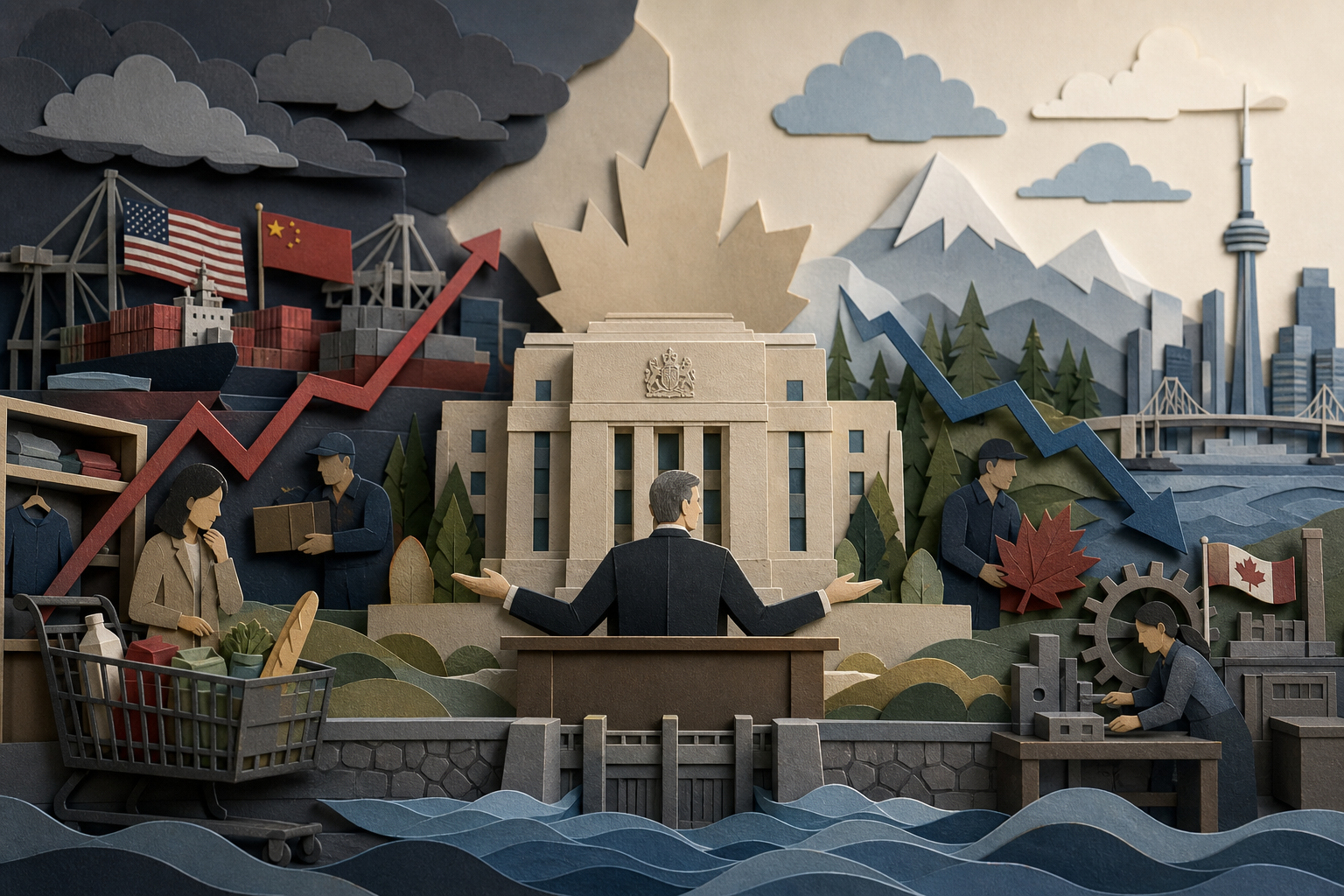
Tiff Macklem faces a problem with no good answer. Tariffs push prices up while choking growth down, and the tools he has available address one risk by making the other worse. Raising rates to cool inflation would deepen a trade-induced slowdown. Cutting them to support growth would let inflation drift above target. The Bank of Canada's next move, almost certainly, will be to do nothing.
The overnight rate has sat at 2.25% since July, and market expectations point to a hold through the October announcement and likely beyond. That steadiness comes from two contradictory pressures cancelling each other out.
The inflation-recession bind
Trade wars create what economists call "stagflation risk." When tariffs go up, the cost of imported goods rises immediately. Canadian businesses pay more for inputs, retailers pay more for inventory, and those costs flow through to consumers at the register. That is inflationary.
At the same time, tariffs reduce trade volumes. A 50% steel tariff doesn't just raise steel prices, it kills deals, delays shipments, and discourages capital investment. Firms that export to the United States face higher costs on their inputs and shrinking demand for their products. Roughly one-third of Canadian GDP is tied to exports, and $3.6 billion CAD crosses the Canada-U.S. border every day. When that flow slows, the economy contracts.
The Bank of Canada cannot fight both problems at once. Inflation calls for restrictive policy. Recession calls for stimulus. A hold at 2.25% reflects Macklem's judgment that current rates are tight enough to keep inflation from drifting permanently above the 2% target but not so tight they turn a mild slowdown into a full recession.
Why the Fed's path matters more than Canada's data
The Bank of Canada does not set policy in isolation. If the Federal Reserve cuts rates while the Bank holds, the Canadian dollar strengthens. A stronger loonie makes Canadian exports even less competitive just as trade barriers are already squeezing volumes. Exporters face the worst of both worlds: higher input costs from tariffs and weaker demand from an expensive currency.
The reverse scenario, cutting rates while the Fed holds, risks capital flight. Investors move money to where returns are highest. If Canadian rates fall too far below U.S. rates, portfolios tilt south, the loonie weakens, and import costs rise. That feeds inflation, which forces the Bank to hike later at a worse time.
The Bank of Canada must stay close to the Fed's trajectory. It has no choice. The Bank of Canada's independence is real. Its ability to move away from U.S. rates is severely limited by the costs to the dollar and inflation.
The mortgage transmission channel
Canadian households feel rate changes faster than their American counterparts. The prevalence of five-year fixed and variable-rate mortgages means that a hold today still tightens policy for anyone renewing in the next 12 months. Mortgage debt-to-income ratios remain near record highs. A household that locked in at 1.79% in 2021 and renews this fall at 4.5% faces a monthly payment increase of several hundred dollars, even if the Bank never hikes again.
That built-in tightening gives the Bank cover to hold rather than cut. The restrictive effect of prior hikes is still working its way through the system. Consumer spending growth has already slowed. Adding further cuts risks re-igniting housing demand before inflation has fully settled.
The structural gamble
Holding rates steady during a trade war is a bet that the current level of restriction is calibrated correctly: tight enough to anchor inflation expectations, loose enough to avoid triggering defaults on corporate debt or a wave of mortgage defaults.
The risk is that trade conditions deteriorate faster than the Bank expects, and by the time the data confirm a recession, the lag in monetary policy means cuts arrive too late to prevent it. The countervailing risk is that tariffs prove more inflationary than recessionary, and holding too long lets price growth become entrenched.
Macklem has called the Bank's approach "data-dependent." In practice, that means waiting until one risk clearly dominates the other. Until then, 2.25% is where rates stay.



Tiff Macklem faces a problem with no good answer. Tariffs push prices up while choking growth down, and the tools he has available address one risk by making the other worse. Raising rates to cool inflation would deepen a trade-induced slowdown. Cutting them to support growth would let inflation drift above target. The Bank of Canada's next move, almost certainly, will be to do nothing.
The overnight rate has sat at 2.25% since July, and market expectations point to a hold through the October announcement and likely beyond. That steadiness comes from two contradictory pressures cancelling each other out.
The inflation-recession bind
Trade wars create what economists call "stagflation risk." When tariffs go up, the cost of imported goods rises immediately. Canadian businesses pay more for inputs, retailers pay more for inventory, and those costs flow through to consumers at the register. That is inflationary.
At the same time, tariffs reduce trade volumes. A 50% steel tariff doesn't just raise steel prices, it kills deals, delays shipments, and discourages capital investment. Firms that export to the United States face higher costs on their inputs and shrinking demand for their products. Roughly one-third of Canadian GDP is tied to exports, and $3.6 billion CAD crosses the Canada-U.S. border every day. When that flow slows, the economy contracts.
The Bank of Canada cannot fight both problems at once. Inflation calls for restrictive policy. Recession calls for stimulus. A hold at 2.25% reflects Macklem's judgment that current rates are tight enough to keep inflation from drifting permanently above the 2% target but not so tight they turn a mild slowdown into a full recession.
Why the Fed's path matters more than Canada's data
The Bank of Canada does not set policy in isolation. If the Federal Reserve cuts rates while the Bank holds, the Canadian dollar strengthens. A stronger loonie makes Canadian exports even less competitive just as trade barriers are already squeezing volumes. Exporters face the worst of both worlds: higher input costs from tariffs and weaker demand from an expensive currency.
The reverse scenario, cutting rates while the Fed holds, risks capital flight. Investors move money to where returns are highest. If Canadian rates fall too far below U.S. rates, portfolios tilt south, the loonie weakens, and import costs rise. That feeds inflation, which forces the Bank to hike later at a worse time.
The Bank of Canada must stay close to the Fed's trajectory. It has no choice. The Bank of Canada's independence is real. Its ability to move away from U.S. rates is severely limited by the costs to the dollar and inflation.
The mortgage transmission channel
Canadian households feel rate changes faster than their American counterparts. The prevalence of five-year fixed and variable-rate mortgages means that a hold today still tightens policy for anyone renewing in the next 12 months. Mortgage debt-to-income ratios remain near record highs. A household that locked in at 1.79% in 2021 and renews this fall at 4.5% faces a monthly payment increase of several hundred dollars, even if the Bank never hikes again.
That built-in tightening gives the Bank cover to hold rather than cut. The restrictive effect of prior hikes is still working its way through the system. Consumer spending growth has already slowed. Adding further cuts risks re-igniting housing demand before inflation has fully settled.
The structural gamble
Holding rates steady during a trade war is a bet that the current level of restriction is calibrated correctly: tight enough to anchor inflation expectations, loose enough to avoid triggering defaults on corporate debt or a wave of mortgage defaults.
The risk is that trade conditions deteriorate faster than the Bank expects, and by the time the data confirm a recession, the lag in monetary policy means cuts arrive too late to prevent it. The countervailing risk is that tariffs prove more inflationary than recessionary, and holding too long lets price growth become entrenched.
Macklem has called the Bank's approach "data-dependent." In practice, that means waiting until one risk clearly dominates the other. Until then, 2.25% is where rates stay.
Sources
Read Next
Canada's U.S. Export Share Falls to 66%: What Three Decades of Trade Data Reveals About Dependency Risk
Toronto Sellers Could Regain Leverage This Fall Despite August Sales Drop
How US Tariffs Could Push Canadian Mortgage Rates Higher Through Four Indirect Channels
Canada's 50% Counter-Tariffs Hit U.S. Dairy and Steel: What the Retaliation Costs Your Supply Chain